Lehrbücher orientalischer Sprachen

(LOS)


edited by Josef Tropper,

in Collaboration with John Huehnergard, Leonid Kogan, Daniel Nicolae, and Juan-Pablo Vita


Sections

I. Cuneiform Languages (Semitic and other languages)

II. Canaanite

III. Aramaic

IV. (North) Arabic

V. South Arabian

VI. Ethiopian

VII. Comparative Semitics

VIII. Egyptian

IX. Afrasian (other Afrasian languages)

X. Varia


I. Cuneiform Languanges (Semitic and other languages)

I / 1

Das Kanaano-Akkadische der Amarnazeit (Josef Tropper / Juan-Pablo Vita)

(ISBN 978-3-86835-023-4) 2010; 163 pp.; 28,- EUR

This book offers a brief but comprehensive introduction to the unusual language of the cuneiform documents from rulers of Canaanite cities in Palestine and environs in the 14th century BCE. The majority of the letters were sent to the Egyptian pharaoh, and were discovered in the archive at Tell el-Amarna (Egpyt). These documents present an Akkadian that is permeated with elements of local Canaanite dialects, especially in the verbal system, use of particles and syntax, to the extent that one can speak of a mixed language, and thus the term Canaano-Akkadian has been adopted in the scholarly literature on this language. The sections of the book are: Introduction; Grammar; Selection of Texts; Glossary; Indices.

I / 2

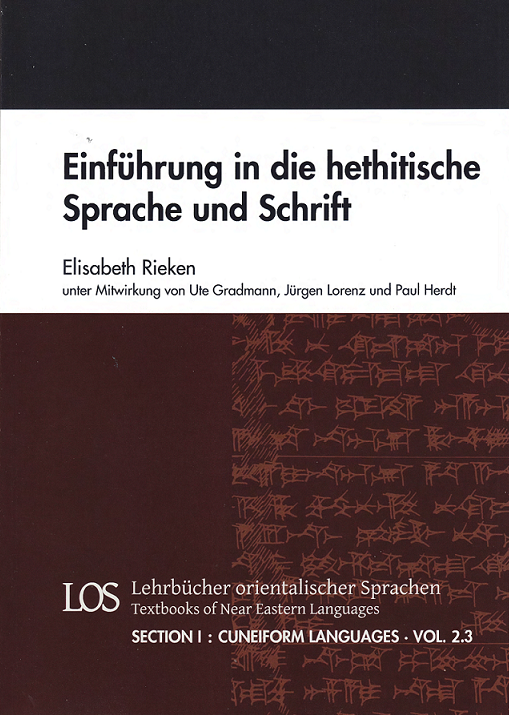
Einführung in die hethitische Sprache und Schrift (Elisabeth Rieken, unter Mitwirkung von Ute Gradmann und Jürgen Lorenz)


(ISBN 978-3-86835-064-7) 2011; 242 pp. 30,- EUR


Hittite, the oldest attested Indo-European language, was spoken in Anatolia in the 2nd millennium BCE and written in the Mesopotamian cuneiform script. As well as having an Indo-European background, the Hittites adopted and adapted the local Anatolian tradition in addition to the North-Syrian (Hurrian) and Mesopotamian cultural achievements including religion, literature and the cuneiform script. They also engaged in international politics and diplomacy. As such, Hittite is of great importance as a source language for the fields both of Indo-European linguistics and Ancient Near Eastern studies. This book presents an introductory course in the Hittite language and script arranged in lessons, each containing a section on grammar and script, exercises, and a text for translation based on original documents. It is intended both for formal course work and for self-study.


III. Aramaic


III / 1

(An Introduction to Egyptian Aramaic (Takamitsu Muraoka)


(ISBN 978-3-86835-065-4) 2012 (in preparation)


This is an introductory grammar of Egyptian Aramaic, a form of Aramaic which occurs in documents originating in Egypt, mostly in Elephantine where there was a Jewish community during the Persian period. They date from the end of the 7th to the third century BCE. Most of the documents are either administrative or legal in nature, but also include some literary pieces such as Proverbs of Ahiqar, private, familial letters, and documents of religious significance. Basic knowledge of Biblical Hebrew is assumed, but not that of any other Aramaic idiom, though Egyptian Aramaic is very closely related to Biblical Aramaic. In the grammar part of the book, the morphosyntax and syntax occupy nearly half of its pages. In addition, there is an anthology of sixteen, quite extensively annotated texts, followed by a glossary covering all the texts included in the anthology and various indices. A useful instrument for students of Aramaic in general, Biblical Aramaic in particular. Throughout the grammar, constant comparison is made with Biblical Aramaic.


in preparation


I. Cuneiform Languanges (Semitic and other languages)


Altakkadisch (Walter Sommerfeld)

Altakkadische Chrestomathie (Walter Sommerfeld / Leonid Kogan)

Sumerian (Christopher Woods)

Old Assyrian (Bert Kouwenberg)

Old Babylonian (John Huehnergard)

Middle Babylonian (Wilfred van Soldt)

Mittelassyrisch (N.N.)

Mari-Akkadisch

Nuzi-Akkadisch (N.N.)

Neo- and Late Babylonian (N.N.)

Eblaitisch (N.N.)

Elamisch (Gerfrid Müller)

Urartäisch (Ilse Wegner-Haas)

Amorite Personal Names (Adelina Millet Albà)


II. Canaanite

Lehrbuch des Biblisch-Hebräischen (Jo Ann Hackett)

Althebräische Inschriften (Johannes Renz)

Althebräische Personennamen (Hans Rechenmacher)

Hebrew of Qumran (Steven E. Fassberg)

Handbuch des Ugaritischen (Josef Tropper)


Phoenician-Punic (Maria Gulia Amadasi)


III. Aramaic

A short introduction to Biblical Aramaic (Daniel Nicolae / Josef Tropper) (ISBN 978-3-86835-021-0, spring 2010)

Historical Grammar of Aramaic (Sergey Loesov)

Samaritan Aramaic (Abraham Tal)

Jewish Palestinian Aramaic (Michael Sokoloff)

Jewish Babylonian Aramaic (Elitzur Bar Asher)

Aramaic of Qumran (Steven E. Fassberg)

Aramaic of the Targumim (Edward M. Cook)

Syntax of Classical Syriac (Aaron Butts)

Nabataean (John F. Healey)

Palmyrene (John F. Healey)

Classical Syriac (Na'ama Pat-El)

Textbook of Classical Mandaic (Charles G. Häberl)


IV. (North) Arabic

Klassisches Arabisch für Hebraisten (Daniel Nicolae)

Textbook of Safaitic (Ahmad al-Jallad)


V. South Arabian

Sabaic Chrestomathy (Christian Robin)

Qatabanian (Alessandra Avanzini)


VI. Ethiopian

Geez (Rebecca Hasselbach / Josef Tropper)


VII. Comparative Semitics

Comparative Grammar of Semitic (John Huehnergard)


South Semitic Scripts (Michael C.A. Macdonald)


VIII. Egyptian

Lehrbuch des Altägyptischen (Jochem Kahl)


IX. Afrasian (other Afrasian languages)


Tarifiyt-Berberisch (Maarten Kossmann / Khalid Mourigh)


X. Varia


Ugarit-Verlag, Ricarda-Huch-Str. 6, D-48161 Münster